Showing Posts From
Java
 Shubham Kumar
- 20 Jul, 2026
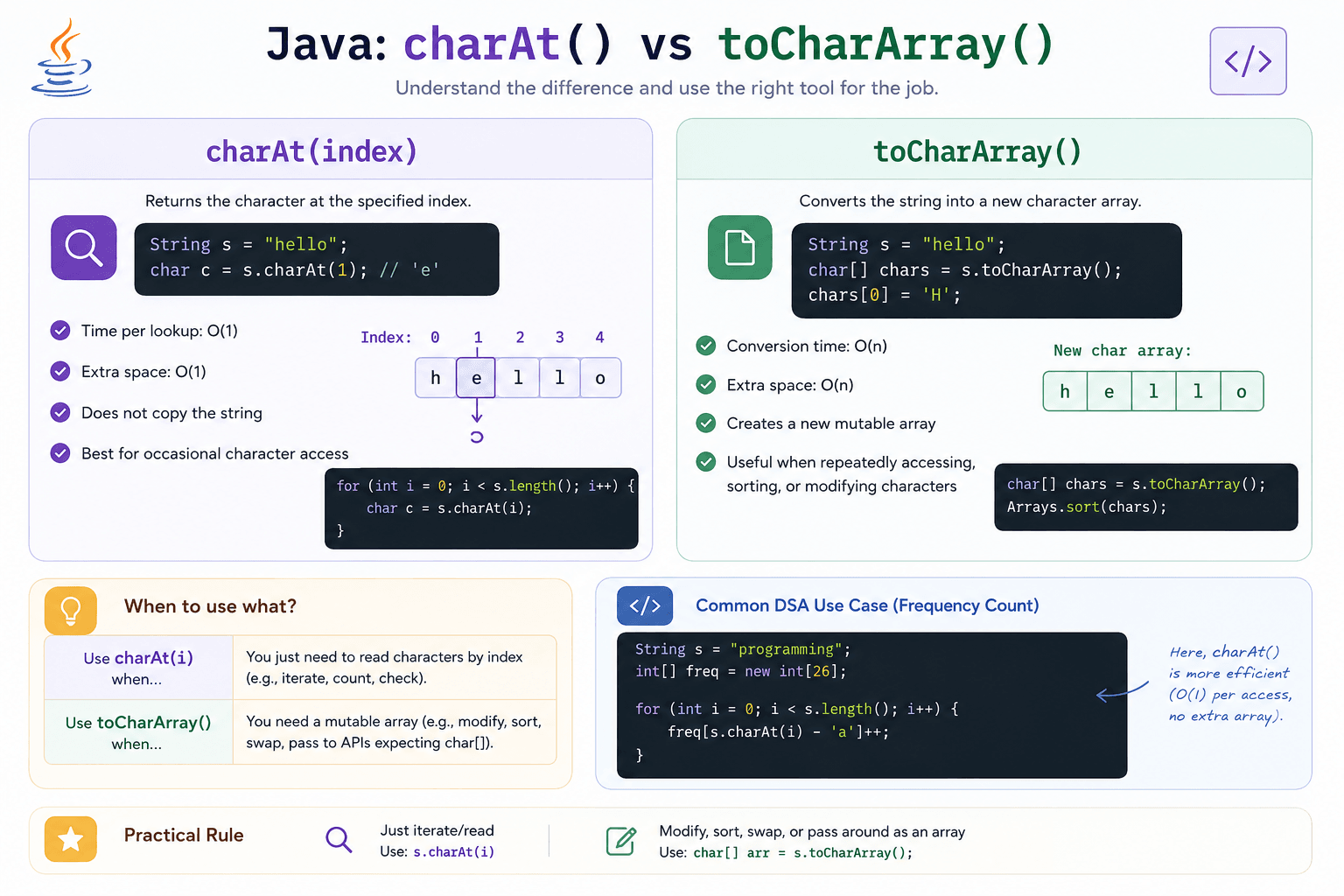
charAt vs toCharArray
String as you know is immutable in java. When you try to manipulate a String object, Java creates a new String out of it. And object creation is expensive. There is a general rule, when you just want to read a character at any index use charAt and when you need to modify the string itself, like rearranging, sorting, creating sub string, breaking it into an array of characters using toCharArray is very cost efficient. toCharArray takes O(n) time for construction of array and O(n) space is also occupied.
- Shubham Kumar
- 21 Jun, 2024
Reflection API in Java
Where is this used? This is used to analyze/modify the behaviour of a class at runtime. Using this, you can view or change the private/public fields at wish (without exposing any getter/setter). Personally, I have used this in one of our projects at GreyOrange to write unit test cases. Using this in main code is a big no-no as it exposed you critical fields to the world. Main Class Let's create a main class for which we will write some test cases. But we want to test some private fields for which we don't have a direct getter. The idea is to use reflection api to access such fields and fetch their current value or modify them if required. Here is a Duck class which has 3 fields of which 1 is static. Each time a duck class is created count which is the static field is increased by one. Each duck has an associated name and age. public class Duck { private String name; private int age; private static int count = 0; public Duck(String name, int age) { this.name = name; this.age = age; count++; } public static boolean canCreateMoreDucks() { return count < 10; } public String getName() { return name; } public boolean canDrinkAlcohol() { return age >= 18; }Test Class -- uses reflection API Change the value of a private field inside a class Field and getDeclaredField are used to access a variable. Using setAccessible as true will expose any private fields which can be manipulated. @Test public void testDuckCanDrinkAlcohol() { Duck duck = new Duck("Donald", 5); assertEquals("Donald", duck.getName()); assertFalse(duck.canDrinkAlcohol()); // change age and check if duck can drink alcohol // But I don't want to create a setter for this // Use reflection API to change the age try { Class<Duck> duckClass = Duck.class; Field ageField = duckClass.getDeclaredField("age"); ageField.setAccessible(true); ageField.setInt(duck, 20); } catch (Exception e) { e.printStackTrace(); assert false; } assertTrue(duck.canDrinkAlcohol());}Get the value of a static private variable in a class A static field can be accessed in the similar way. @Test public void testDuckCanCreateMoreDucks() { // Instead of creating more ducks // I will use reflection API to change the count Duck duck = new Duck("Donald", 5); assertTrue(Duck.canCreateMoreDucks()); // Also assert count was 1 // But I don't want to create a getter for this try { Class<Duck> duckClass = Duck.class; Field countField = duckClass.getDeclaredField("count"); countField.setAccessible(true); // Don't need to pass an instance as count is static Object countObject = countField.get(null); int count = (int) countObject; assertEquals(1, count); } catch (Exception e) { e.printStackTrace(); assert false; } }Change the value of a static private variable in a class You can use setInt to change the value of the Field. @Test public void testDuckCannotCreateMoreDucks() { // Instead of creating more ducks // I will use reflection API to change the count Duck duck = new Duck("Donald", 5); // change count to 10 try { Class<Duck> duckClass = Duck.class; Field countField = duckClass.getDeclaredField("count"); countField.setAccessible(true); countField.setInt(null, 10); } catch (Exception e) { e.printStackTrace(); assert false; } assertFalse(Duck.canCreateMoreDucks());}